
Computational Chemistry
Marking Feedback
There are individual comments/annotations added to each assignment pdf on blackboard
Overall a wide spread the average was 21/40 =53%

Model answers here
General comments on where people did well and where people had problems:
- Optimisation of H2BCl
- almost all students optimised the molecule, well done!
- a few students submitted the wrong file
- a significant proportion of students failed to provide the standard evidence that the optimisation is complete, this information was highlighted in the web-page, indicating students perhaps read the web-page only once, and did not go back to "check" they had the right information
- many students who did report the low frequencies failed to link these to the convergence of their structure, this indicated a lack of understanding of the purpose of reporting this data, remember in an assignment you are convincing the marker that you know what you are doing & understand what is going on and are not just executing a list of requirements.
- many students who achieved all Item table components yes for the optimisation but not the frequency did not comment on this fact, computational chemistry is just like synthetic chemistry in that you do need to report "what you see"
- Frequency analysis of H2BCl
- everyone produced a table, and a large number of people worked out the correct vibrations, well done!
- some students missed putting the units on their tables
- a surprising number of students reported numbers to the wrong number of significant figures, this information was available in the lab description, and even identified as important, again indicating material was not read closely enough
- MO diagram of H2BCl
- well done to everyone who had a go at this, there were a number of outstanding answers
- a proportion of people found this very challenging and I suggested that you look at the model answers and take another look at the course notes, I would also suggest having a go at the "extra" practice examples
- MO diagram of H2BCl
- well done to everyone who had a go at this, there were a number of outstanding answers
- a proportion of people did not provide enough information in the annotations, I needed to be told why an interaction was weak or strong and what type of interaction it was. I often suggested that you look at the model answers
Key changes to implement next year:
- a longer "mini-lab" session to allow people to take their time
- emphasising more that the lab content does need to be read more than once (using the above experiences to emphasise the importance of this to students)
- encourage attendance at the tutorial on MOs
Assignment (40 Marks)
Hand in on blackboard at BB Assignments
Important You will need to hand in a pdf file (Firstname_Lastname_assignment.pdf ) and a log file (Firstname_Lastname_BH2Cl.log). Do NOT use spaces in any of these file names, use an underscore instead. Failure to follow this format will be penalised. This format is necessary because I will be using python scripts on a unix based OS to process your files. If you have any problems contact me!
Hand in is 5pm on Weds 7 October
- Optimisation of H2BCl (10 Marks)
- optimise H2BCl using the B3LYP/6-31G(d,p) method and basis set
- provide the standard evidence that the optimisation is complete
- if your optimisation is almost converged but the "distances" are just outside of the convergence range, re-run starting from last step and turn off the "tight convergence" checkbox, it will then converge
- submit your logfile
- Frequency analysis of H2BCl (10 Marks)
- provide a table of the vibrations that includes: vibration number, symmetry label, wavenumber and intensity
- identify the nature of each mode using the following descriptors:
- B-Cl stretch
- BH2 asymmetric stretch
- BH2 symmetric stretch
- BH2 symmetric bend
- umbrella motion
- BH2 wag
- Which vibrations are unlikely to be observed in an experimental spectrum?
- MO diagram of H2BCl (10 Marks)
- construct a stage 1 valence MO diagram using BH2 and Cl as the fragments, assume that the Cl 3sAO is non-bonding
- show how the mixed orbitals are generated
- construct a stage 1 MO diagram by including the mixing, the computed MOs will be helpful
- MOs from a calculation on F2BCl (10 Marks)

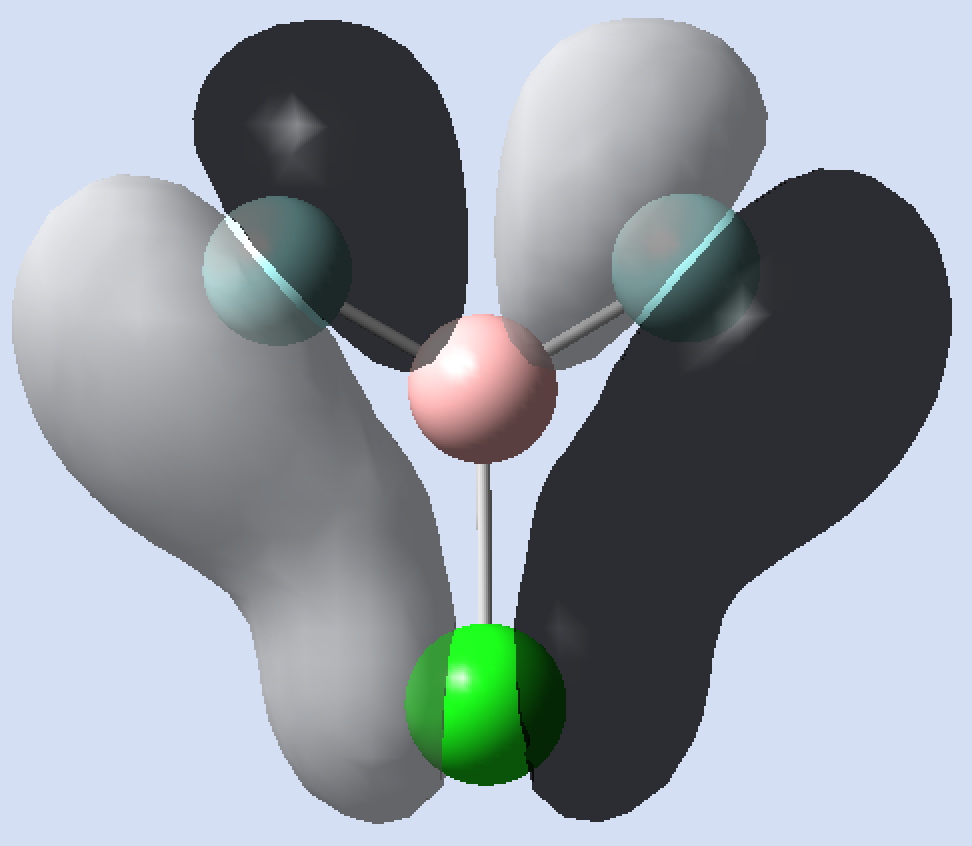
MOA MOB - annotate a LCAO chemdraw (or tidy hand-drawn) diagram for each of these MOs (you are expected to provide at least 5 descriptive annotations total) I must be able to read your handwriting.
- I've just discovered chemdraw is not currently available to students currently, and I'm pursuing getting it installed on some of the department computers, in the mean time I will accept a TIDY hand-drawn diagram.
- identify the overall character of each MO