
Computing alpha and beta parameters for ILs
Predicting α by Computing EPnuc
Calculating the electrostatic potential at the position of an atom is very straightforward. We need only run a single point calculation on our optimised cation with the additional property keyword. (Single point means we don't need to move the atoms as in an optimisation, we are only completing a single set of SCF cycles to obtain the correct electron density)
Open your completed log file from your frequency calculation, choose calculation set-up (all of the options should be set because you are opening an already completed job). Unselect Freq (as this is expensive and you don't want to repeat it) In the Additional Keywords line add the keyword prop, then submit this job. Don't forget to save it to a new name or you will overwrite your frequency analysis file!
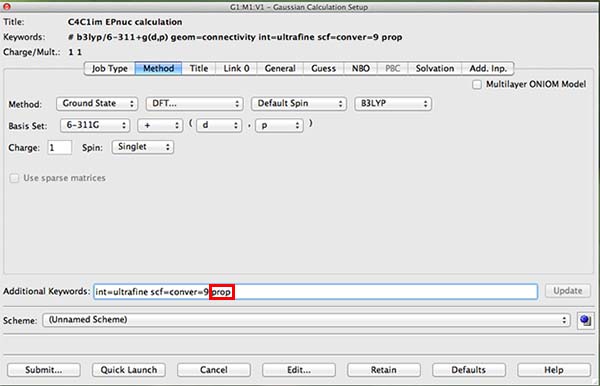
Example input and output files for the property calculation:
Once the job has completed, open it in gaussview. We obtain the calculated EPnuc values by looking at the relevant section of the log file. The log file is the actual text based output, so from the menu at the top of the screen choose "Results" and then "view file" and the text file will be displayed. You need to scroll down until you find the following heading:
**********************************************************************

            Electrostatic Properties Using The SCF Density

**********************************************************************
All the calculated electrostatic properties are found after this heading. The calculated EPnuc values for each atom in the system are found in a table called "Electrostatic Proerties" and are under the column heading Electric Potential. An example for the [C4C1im]+ cation is shown below.

The EPnuc values of smallest magnitude will correspond to the most H-bond acidic proton in the system (these numbers are negative, so the smallest number corresponds to the "most positive" of the negative values).
In the example above, atom 8 has the EPnuc of smallest magnitude, with a value of -0.873206. To identify the atomic numbering you need to choose from the menu at the top of the screen "View" and then "labels", and the atom numbers will appear on the molecule.
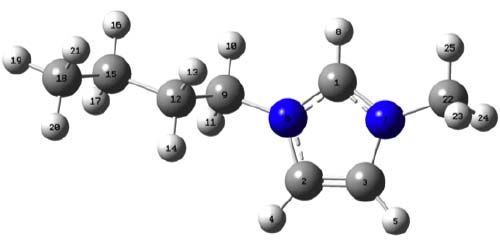
Unsurprisingly, atom 8 corresponds to the NCHN proton.
Just because the output presents the value to 6 decimal places does not mean this number is meaningful to that accuracy! We consider differences in EPnuc up to the second decimal place (2dp) meaningful for comparison, and so recording this number to 3dp is normally sufficient.
ΔEPnuc for this example is therefore is -0.873.
Predicting Alpha α
The computed value of EPnuc for [C4C1im]+ is -0.873, putting this value in the equation α=5.153*EPnuc +5.136, yields a value of α=0.64.