
Ionic Liquids Research
Areas of intrest and research including current projects
Ionic liquids are a fascinating new type of solvent. While the physical properties of these solvents are being progressively explored the fundamental electronic structure and molecular level interactions remain largely unknown. The uses for ionic liquids continue to expand, and new ionic liquids are constantly being developed for targeted applications.The following topics include current areas of active research and new project areas. Click on a link, or scroll down to see each topic.
A-priori prediction of IL character
Kamlet and Taft developed a method which correlates the relative effects of a solvent to the absorbance spectrum of a selection of dyes (one of which is nitroanaline) to quantify the polarizability (pi), H-bond donor ability (alpha) and H-bond acceptor ability (beta) of solvents in general. Our collaborator, Prof Tom Welton has applied this method to investigate the characteristics of ionic liquds. We use ab-initio quantum chemical methods with small probe molecules to evaluate these parameters. This means we can model prospective ILs and predict their characteristics before the more expensive and labourous process of synthesis is attempted.

4-nitroanillne dye interacting with an IL anion
doi A step towards the a-priori design of ionic-liquids, H. Niedermeyer, C. Ashworth, A. Brandt, T. Welton and P. Hunt PCCP, 2013 15, 11566-11578
The Viscosity Challenge
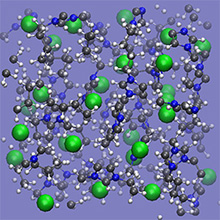
Functionalised Ionic Liquids
The basic IL cations (and to a lesser extent the anions) have been functionalised with carboxylic acids, alcohols, ethers, nitriles, amides, thioureas, siloxanes ... however how the functional group effects the physical and chemical properties of the IL are not well understood at the molecular level. We use ab-initio methods to investigate the electronic structure and H-bonding with the aim of building rules that can be used to predict and rationalise the effects each type of functional group has on the IL.
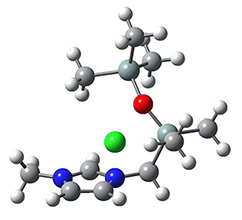
Siloxane functionalised imidazolium based IL
Hydrogen Bonding in Ionic Liquids: Exotic or Ordinary?
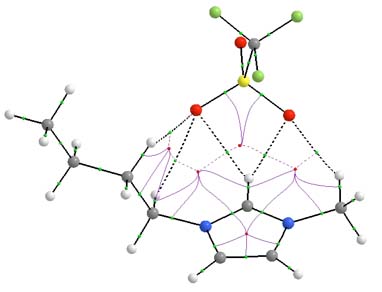
aim analysis of IL ion-pair
doi Hydrogen Bonding in 1-Butyl- and 1-Ethyl-3-methylimidazolium Chloride Ionic Liquids, I. Skarmoutsos, D. Dellis, R. Matthews, T. Welton, and P. Hunt, JPCB, 2012, Vol 116, Iss. (16), p4921-4933
Normally H-bonds exist between two neutral species, or in a cation-neutral or anion-neutral arrangement. However, in ILs the H-bonds formed are between ions. This kind of H-bond has not been documented, and displays unique characteristics. We use ab-initio methods to investigate the electronic structure of these H-bonds, and classical methods to investigate the dynamic nature of these H-bonds.
The dynamics of H-bonds in water is well studied, in contrast the dynamics of the H-bonds in ILs are largely unknown. We have established that the criteria for defining H-bonds used in molecular liquids do not revieal the whole story of H-bonding in ILs. H-bonds in IL are less structured and more diverse.
Protic Ionic Liquids: Ionic or Neutral?
Protic ILs have an "available" proton, usually this is supplied by the cation but can also be delivered by the anion. Protic ILs are not pure ILs because the proton transfer is an equilibrium process. We use ab-initio methods to investigate the proton transfer and stability of the ion-pair vs the neutral acid-base components of the IL.
Current MRes Green Chemistry Project
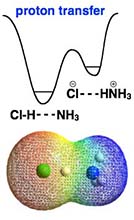
potential energy surface for proton transfer showing the electrostatic potential for Cl-H-NH3
Aqueous Contamination of ILs
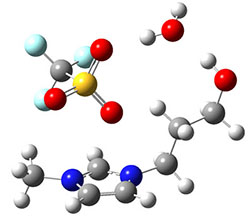
water inserts between the cation and anion of a OH functionalised IL
doi Why are ionic liquid ions mainly associated in water? A Car-Parrinello study of 1-ethyl-3-methyl-imidazolium chloride water mixture, C. Spickermann, J. Thar, S. Lehmann, S. Zahn, J. Hunger, R. Buchner, PA Hunt, T. Welton, B. Kirchner, J. Chem. Phys., 2008, Vol 129, Iss. (10), no 104505
Thermochromic Materials
Nickel complexes change colour when heated in an ionic liquid.
[NiCl4]
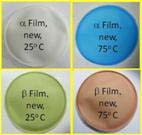
thermochromic composite films formed with ILs
Available project
Novel Conductors
Mixtures!
What happens when you mix ILs? Do particular ions favour pairing, or do they mix in an ideal manner? Are nano-structured domains formed?
What is the difference between functionalising an IL and mixing the pure IL with an equal proportion of the neutral solvent? What happens when we mix an alcohol or another neutral molecular solvent with an IL? Both H-bond but in very different ways.
doi Salts dissolved in salts: ionic liquid mixtures, M. Lui, L. Crowhurst, J. Hallett, P. Hunt, H. Niedermeyer and T. Welton Chemical Science, 2011, Vol 2, Iss. (8), p1491-1496
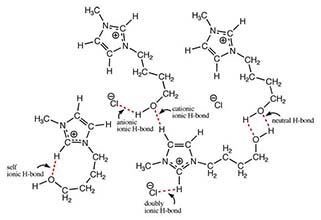
H-bonding within a functionalised ionic liquid