if you can't remember what an optimisation does, please go back to the first lab for a reminder, it is assumed you know this material
When carrying out a calcuation we are solving the Schrödinger equation multiple times (once for each step on the optimisation process) HΨ=EΨ. We are solving for the energy and the wavefunction, this leaves two key components that have to be predefined in some manner, the method (the particular type of hamiltonian employed) and the basis-set (the way in which the wavefunction is described).
As you progress through your degree you will gain the mathematics and quantum mechanics that you need to understand this better, starting with your theoretical methods course next year and culminating, if you are interested, in a number of fourth year courses, one of which is computational inorganic chemistry.
In this lab you are going to use a "work horse" general method commonly called DFT which stands for Density Functional Theory. DFT has a large number of different possible flavours, we will use a very popular version called B3LYP
Basis sets determine the number of functions used to describe the electronic structure. I think showing you a simple example is the best way to get started.
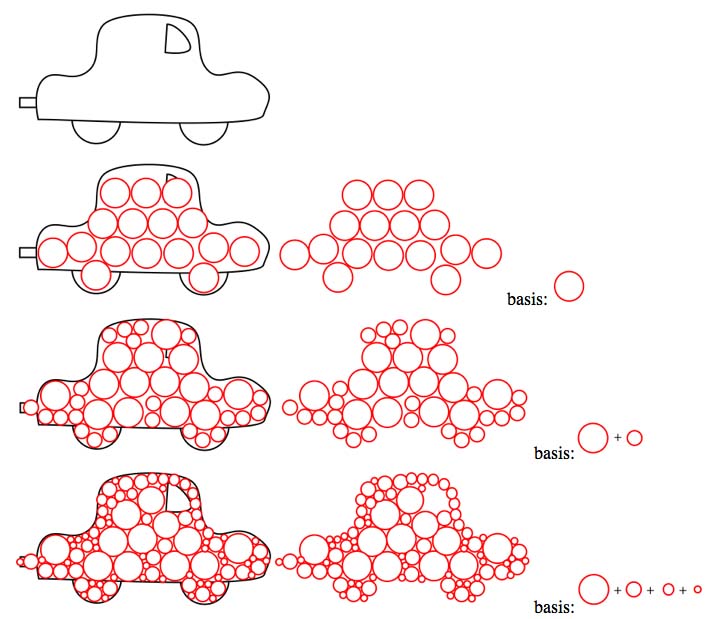
Say I have a shape I want to describe, for example a car as in the diagram. I could describe this shape with a single basis function (a circle). If I use only one basis function (a circle) of a given size, the shape of the car is not well reproduced. However, if I allow my circles to vary slightly in size, ie if I increase my basis set to two functions I get a better fit, and if I allow even more functions I can describe the shape of the car very well! If we add too many basis functions the calculation will take too long, so we always have to balance computational difficulty vs the size of the basis set.
Basis sets are named for the number of functions used to describe core and valence electrons, and for how much variation is allowed in the wavefunction description, they tend to be described as core functions "dash" valence functions. For example the 3-21G basis set has 3 functions for each core orbital with limited flexibility (the first 3 in the description), and 3 functions for each valence orbital with a 2+1 pattern which gives it more flexibility (the 21 in the description). The G stands for the use of gaussian type functions.
A more complex basis set is the 6-31G basis set which has six functions for the core orbitals and 4 functions for the valence orbitals in the pattern 3+1. We can make a basis set better by adding functions of higher angular momentum, this is typically extra d-functions for first row atoms and extra p-functions for the H-atoms, and is indicated by (d,p) in brackets after the main description. For example the 6-31(d,p) basis-set.
Calculations with a large basis set take much much longer than those with a smaller basis set. So you should always start an optimisation with a lower basis set, optimise the molecule and then refine this further by switching to the larger basis set.
The procedure we will follow in this lab will be to:
use the B3LYP method
first optimise with the 3-21G basis-set, this is our quick "tidy-up" of the geometry calculation
then we will take the output of the lower level calculation and use it as the input for our higher level calculation, starting an optimisation using the 6-31G(d) basis-set and including some extra commands to improve the description of the electron density
then we will compute a frequency analysis with the 6-31G(d) basis-set (and extra options) to ensure we are at a minimum
The 6-31G(d) basis-set has a medium-low level of accuracy, and using this basis set means the larger calculations will still be quick enough to complete in the lab. A much better basis set would be the 6-311G(d,p) basis set.
You should be aware that in a research environment it is normal for a job to run anywhere from several hours up to 10 days, 2-3 days being a more average amount of time. So the calculations you are carrying out here have been chosen at a lower level than we would normally employ.
When you are ready move onto the next step which is setting up the the electronic part of the optimisation