
Pseudo-potentials and basis sets
In this part of the lab you will gain experience in using larger basis sets and pseudo-potenitals, essential skills if you want to use computational chemistry to study inorganic systems, especially catalysis or main group metal containing compounds. Heavy atoms in particular exhibit relativistic effects which cannot be recovered by the standard Schrodinger equation and normal basis sets. However, we can recover some of these relativistic effects by using a pseudo-potential.
Most of chemistry is based on the assumption that it is really the valence electrons that dominate in bonding interactions, and so we can safely model the core electrons of an atom by a special function called a pseudo-potential (PP) or an effective core potential (ECP), they are different names for the same thing, pseudo-potentials make calculations much easier.
Important PPs should ONLY be used on heavy atoms, definitely on atoms in the third row and below, and on second row atoms (Si, P, Cl etc) only if the situation warrents it (ie the calculation would otherwise take too long). Pseudo-potentials have been used for a long time and so we know they are accurate and do not effect the results significantly for heavy atoms (of course this all depends on the level of accuracy you want!).
When treating second row atoms and above, we also need to use a reasonable basis set. Basis sets determine the number of functions used to descripe the electronic structure. I think showing you a simple example is the best way to get started.
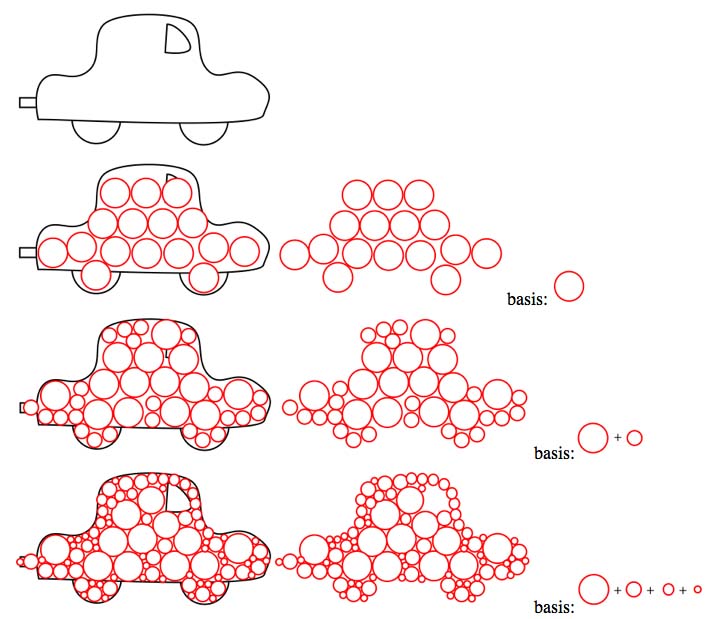
In addition to adding more generic functions we can add functions that do specific things, for example, diffuse functions allow the electron density to extend out and away from the molecule, important when we are considering anions, or very soft elements. Polarization functions allow the electron density to become polarized to one side of a molecule. Both types of function are important for an accurate description of most inorganic molecules where the electron density is moving around and the basis sets must be good to accommodate this ebb and flow.
now lets move on to using larger basis sets and a pseudo potentials in our calculations