
Surface Tension of Water

Water beads on flower petals
What does a "high surface tension" mean?
Where water and air meet there is a "surface". Water molecules at the surface have only air above them, and thus nothing to form H-bonds with; the "red" H-bonds on the diagram below represent the "missing" H-bonds at the surface of water. The stars label the "high energy" surface molecules.
Surface tension is just a way to measure or quantify this property, surface tension is the energy per unit area. A high surface tension means there is a strong energy drive to mimimize the surface area.

At the air-water interface are high energy watr molecules which cannot form as many H-bonds.
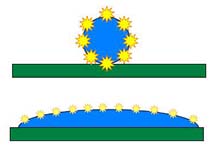
High surface energy = high surface tension (top) and low surface energy = low surface tension (bottom).
Droplets form when the surface energy is very high, when the surface energy is small, the droplet can spread out and "wet" the surface. This property of water is the basis for water repellant fabrics and surfaces, fabrics which do not like to interact with water cause beading, fabrics that interact with water get wet!
Molecules on the surface feel the pull of molecules from below and to the sides via the H-bonds, but nothing from above (where there is air). Although there are fewer H-bonds these can be a bit stronger and thus the surface molecules feel unbalanced forces pulling them tightly together.
You can think of this as like a stretched sheet of rubber or "cling film" on the surface of the water, the surface is under tension.
Surface tension is also defined as the force per unit length, a high surface tension means there are stronger forces pulling the molecules together. A low surface tension means the molecules are more relaxed the forces between them are smaller.

Forces acting on the surface molecules pull the water molecules "tightly together".

Surface area calculations
we want to show that the surface area of a sphere is smaller than the surface area of a cube or cylinder:let us assume that all these shapes contain the same volume V=10 cm3
going through this process we find the surface area of a
- sphere is 22.6 cm2
- cylinder is 31.1 cm2
- cube is 27.7 cm2
it doesn't matter what volume we choose the surface area of the sphere will always be the smallest
cube

sphere

cylinder
